
Author: webmaster
Finally, Scientists Say They Have the Answer to One of Nature’s Biggest Questions

Though there have been enormous advances in scientific observations about nature over the years and many questions still remain, scientists think they can file one away as “answered.” It being: Why does a zebra have stripes?
One might think the animal from the equine family wouldn’t have black and white stripes as a source of camouflage, standing out to predators among the tan grasses of sub-Saharan Africa. But what if the predator it was trying to avoid wasn’t lions or other carnivores.
Think much smaller.
Researchers at the University of California-Davis say that the stripes most likely are to ward off biting flies.
The team looked at previous hypotheses as to what the benefit of stripes could be, which included camouflage, disrupting carnivores’ attack, heat management, social function and avoiding disease carrying insects, such as flies.
The only one that stood out among the researchers’ observations was the latter — avoiding blood-sucking flies.
To come to this conclusion, the team mapped the geographic location of seven different zebra and other horse species, noting any observations about stripes on their bodies — how thick were the stripes; where were they located; how many stripes were there; etc. Then, they analyzed the geographic regions these species were from, taking note of various factors in this region, such as predators, temperature and distribution of different biting fly species.
Where these factors overlapped is where the scientists found their answer.
“I was amazed by our results,” lead author Tim Caro, professor of wildlife biology at the university, said in a statement. “Again and again, there was greater striping on areas of the body in those parts of the world where there was more annoyance from biting flies.”
To Caro, this study gives ecological validity to the biting fly hypothesis over the other options as to why zebras have stripes.
“No one knew why zebras have such striking coloration,” Caro said. “But solving evolutionary conundrums increases our knowledge of the natural world and may spark greater commitment to conserving it.”
Other questions that have yet to be answered by the study include why would flies avoid a striped surface and what made zebras so susceptible to biting flies that they would develop such a pattern. One hypothesis is since zebras have shorter hair than other mammals in the area, it could be easier for biting flies, which can carry parasites, to attack them.
The researcher’s findings were published in Nature Communications. Just in case its appearance in a reputable scientific journal isn’t enough, NBC News confirmed that this wasn’t an April Fools’ Day joke.
Probe into deaths of six birds of prey in Ross-shire

Police have launched an investigation following the discovery of six dead birds of prey.
The five red kites and a buzzard were found in the Conon Bridge and Muir of Ord area of Ross-shire.
The raptors were found at different, but nearby, locations between 18 and 24 March.
Police Scotland said it was unclear at this stage how the birds died, but said it was likely the deaths involved “some form of criminality”.
Det Insp Scott McDonald said: “I would ask anyone who has been working on the land or using the area for recreational purposes to contact us if they have seen anything suspicious that may be linked to this incident.”
RSPB Scotland has been assisting the police inquiry.
‘Hugely disappointing’
Duncan Orr-Ewing, head of species and land management, said: “It is potentially a very serious wildlife crime incident.
“We are currently awaiting confirmation from the authorities as to whether this incident is a wildlife crime or a natural incident.”
He added: “Irrespective of whether a crime has been committed here or not, to lose such a large number of red kites at one time from the small Black Isle population is a major setback to this important conservation programme for Europe’s only endemic, and highly vulnerable, raptor species.”
Scottish Gamekeepers Association (SGA) chairman Alex Hogg said the deaths were “hugely disappointing”.
He said: “We would ask anyone who knows anything about this mindless act to contact Police Scotland and to assist with the investigation.
“Clearly, until the post-mortem and toxicology reports are known, there is little information to go on.
“However, the SGA condemns wildlife crime and advocates only legal means to solving conflicts.”
Landowners organisation, Scottish Land and Estates, said it supported the police investigation.
Rachel Stevens and husband Alex Bourne welcome baby girl

The former S Club 7 singer and her husband Alex Bourne – who already have a three-year-old daughter Amelie together – welcomed a second daughter last night and took to their Twitter accounts to announce the happy news.
Alex, 36, wrote: “Delighted to announce the safe arrival of our gorgeous little girl! @MsRachelStevens and baby both really well. Amelie happy and ‘cited’ x.”
And although the pair have yet to name the little one, they revealed that they are “totally smitten” with the newborn, who weight 7lbs 7oz.
“Needless to say, we’re all super excited, especially Amelie who is looking forward to meeting her new little brother or sister.”
Rachel and Alex have been married for four years.
Alanis Morissette’s husband fears stolen dog will be kidnapped

ALANIS MORISSETTE’s rapper husband MARIO TREADWAY fears their stolen pet dog will become a kidnap target if a legal battle with the couple’s former housekeeper continues to play out in the public eye.
Treadway filed suit against Maria Garcia last month (Mar14), accusing the former employee of stealing the couple’s pooch, Circus, when she was fired from her role as their house manager in January (14).
He claims Garcia wanted to keep the dog as part of her severance deal, but the plaintiff refused and instead asked a Los Angeles judge to force her to return the animal immediately, in addition to £15,600 in damages.
However, Treadway has now lodged new papers in court, claiming the longer the case goes unresolved, the higher the risk of Circus being taken by dognappers and held for a bigger ransom, reports TMZ.com.
In the new documents, the plaintiff’s lawyer writes, “(Circus) is not merely a piece of property. He is living and breathing”, adding that each day Treadway is separated from the pooch, his “heart suffers more and more”.
And he insists a YouTube.com video featuring Garcia and her partner, the couple’s former dogwalker Patrick Murch, cuddling up to Circus has only increased the dog’s risk of kidnapping, and he is calling on a judge to step in to end the fight.
Russell Crowe meets with Archbishop of Canterbury
 The religious leader agreed to meet with the movie star for a brief chat about his new film Noah, which debuted at the top of the U.S. box office at the weekend (30Mar14).
The private get together at Lambeth Palace took place after Noah’s London premiere on Monday (31Mar14).
The two men talked about faith and spirituality.
The meeting was a big boost for the biblical epic, which has come under fire from many religious groups for its retelling of the Noah story.
Crowe has defended the film, stating, “It has something for people of faith and people who don’t have faith. It’s an intense experience. You come out of it wanting to have a chat. That’s the best part of a movie when that sort of thing happens.”
News of the meeting comes weeks after the actor was denied a private audience with Pope Francis after lobbying to have Noah screened for the pontiff to prove to religious critics that there is nothing blasphemous about the movie adaptation.
Instead, the actor and his director Darren Aronofsky were invited to join the official VIP section of the Pope’s general address in the Vatican in Italy on 19 March (14).
Can city farms feed a hungry world?
What’s for dinner? For that matter, what’s to eat, full stop? In a few decades time, that second question may become pressing. Mankind’s awareness of our food supplies has been heightened by massive crop failures due to millennial level floods, protracted droughts, and numerous food-borne disease outbreaks caused by microbes such as salmonella,E. coli strain 0157, toxoplasma and listeria. Consumers the world over now demand to know where their food comes from and how it is produced.
As if that were not enough to keep us up at all hours of the night, larger issues loom in the near future as our population continues to expand, placing greater pressure on the world’s agricultural industries to meet demands. As a species, we need to know whether modern farming is sustainable and compatible with the rest of the natural world, or is it causing irreparable damage to the environment that will eventually turn today’s serious problem of today into a food crisis of epic proportions in the near future?
To answer some of these questions, it’s important to recall how things got this way to begin with. In the beginning of the modern era of humankind, around 10,000 years ago, most of our earliest cities were located close to agricultural land. Cities needed crops.
In the Middle East, for example, einkorn wheat was first successfully cultivated around 11,000 years ago in the south-eastern part of what is now Turkey. Farming then rapidly spread through the whole of that region. It had many advantages, including the fact that when wheat yields exceeded demand, its grain could be stored without losing any nutritional value. These early cities – Ur, Nineveh, Jericho, Babylon – became established next to their farmland, and for a time flourished in concert with the fields that provided their sustenance. Yet despite the invention of farming, eventually all of these early cities fell into disrepair, their decaying fortified walls and crumbling buildings blending seamlessly back into the harsh, arid landscapes which gave rise to them. The cause? Desertification. Drier weather patterns caused the failure of this single crop their civilisation depended upon – a mono-crop dependent upon a constant source of water to survive. It was irrigation which allowed such large amounts of wheat to be grown – but falling water levels brought the Middle East’s first agricultural revolution to an end. Only Egypt survived in the long term, thanks to the Nile River.
Today’s cities are at risk from a different set of issues. If trends in urbanisation continue at their current rates, cities could evolve into places where intolerable numbers of people may have to live, and who are forced to live well below the poverty limit, threatening to overwhelm sanitation systems and housing. Food and drinking water would be even scarcer than in many of today’s developing cities.
But this doesn’t have to happen. Most urban centres are experiencing a re-birth of their direct connections to agriculture. Within just the past 10 years, an increasing interest in city farming has been paralleled by the creation of the slow food and locallly sourced, or “locavore” movements, a foundation for the rise of urban farming initiatives.
Bright lights, big city
Included in the mix of successful city-based agricultural projects are rooftop gardens, rooftop greenhouses (both low tech and hydroponic), above-ground planting beds, the use of empty lots as farmland, and vertical farms that occupy tall buildings and abandoned warehouses. Collectively, these examples show the validity of growing food in the city. Not only could be they be carried out efficiently – such as rooftop greenhouses giving much higher yields than outdoor farms – but they could also operate without the pollution associated with outdoor farming.
Already, we have large-scale indoor farms such as EuroFresh Farms in Willcox, Arizona (318 acres (1.3 square km) of one-storey-high hydroponic greenhouses), supplying fresh tomatoes and cucumbers, andFarmedHere in Bedford Park, Illinois, a 90,000 square-foot (8,360 square metre) empty warehouse several storeys tall that was converted into an indoor farm producing tilapia (freshwater fish), a variety of leafy green vegetables, and several value-added products. Indoor farms (controlled environment agriculture or CEA) will undoubtedly replace most outdoor urban agricultural initiatives as the advantages of farming within protected environments become more widely accepted.
Judging by current trends in the development of advanced technologies, city-based CEA appears to have a bright future, as newer strategies emerge enabling indoor farming to be carried with increasing efficiency. Grow lights, for instance, have evolved from ordinary fluorescent light fixtures – expensive to operate – into a series of light-emitting diode (LED) lighting schemes. These LED lights can be adapted to emit light spectra at two dominant wavelengths (red 680nm; blue 460nm) tailored for growing green plants. The benefits of LED grow lights are obvious when compared to other outdated lighting schemes: LEDs cost less to run, and produce greater yields of most commercial crops, such as leafy greens and tomatoes. In early 2013, Phillips in the Netherlands announced it had invented an LED light with energy efficiency 150% greater than existing LED grow lights. This new development promises to significantly reduce energy costs involved in growing such crops.
Although most current vertical farming operations have chosen to specialise in cash crops consisting of leafy green vegetables (easy to grow and much in demand), in the near future, consumers are likely to ask for a wider variety of vegetables and fruits grown without pesticides, herbicides and other harmful chemical contaminants. At that point, vertical farming in tall buildings will replace less productive single-story greenhouses as the source of all city-grown produce. Some form of vertical farming now exists in Japan, Korea, Singapore, the United States, and Canada. New vertical farms are planned for a number of cities in the United States (Milwaukee, Memphis and Jackson Hole in Wyoming), andLinköping, Sweden.
Urban agriculture has the potential to become so pervasive within our cities that by the year 2050 they may be able to provide its citizens with up to 50% of the food they consume. In doing so, ecosystems that were fragmented in favour of farmland could be allowed to regain most of their ecological functions, creating a much healthier planet for all creatures great and small.
Ocean living: A step closer to reality?
The 1995 film Waterworld was one of Hollywood’s most infamous budget busters – a mega-million-dollar post-apocalyptic thriller that, at the time, cost more than any other film ever made. It did a pretty decent job of sinking Kevin Costner’s career for the rest of the decade. More importantly, it may also have helped do the same to the idea of mankind living on the sea.
Though scientists aren’t predicting sea-level rises of the magnitude seen in Waterworld – hundreds of feet thanks to melting polar ice caps – we may have to plan for a world with much higher sea levels. There has long been a dream that one day mankind, or at least some of us, will live on the ocean. Designer and architect Buckminster Fuller saw cities at sea contributing to a sustainable future for humanity. But then floating cities evoked images of flop films, or worse, of wealthy “robber barons” escaping to the high seas for financial reasons. Now, several groups are trying to change this perception by researching technologies that could help create floating cities, or “seasteads”, which become innovative models of sustainability and peaceful cooperation.
Does this sound too futuristic? Then consider China’s Fujian Province,where the Tanka people have been settled at sea since 700AD. Pushed into coastal waters in wartime during the Tang Dynasty, these boat dwellers weren’t allowed to set foot on land until the second half of the 20th Century. Today, some 7,000 Tankas still maintain a sea farming life – possibly a preview of a future to come for many more of us. Before the industrialisation of agriculture, most people lived in land-based villages no larger or more complex than the Tankas’ simple water-based community. It took a series of green revolutions in farming technology to allow people to leave rural communities, and move into densely-populated urban areas. We see signs that a “blue revolution” in ocean harvesting technology is underway, suggesting floating cities can’t be far off.
Supply issues
It may be a necessity – not merely a novelty – to inhabit the sea in the coming decades, but to do so will require the means to create reliable and sustainable food and power souces. Dwindling fish stocks from overfishing have prompted humanity to create farmed supplies, beginning with the most accessible environments on or near land. Yet most fish farming has not evolved beyond the low-tech cages and seaweed-draped lines anchored in shallow seas by ancient peoples like the Tankas. The most advanced methods of mass production employ harmful antibiotics and genetically modified feed in unnaturally crowded ponds on land.
But the drawbacks of current fish farming has created opportunities for technology like the floating “drifter pens” pioneered by Kampachi Farms. Given enough time, Kampachi Farms will replace stagnant ponds with GPS-tracked cages stitched out of copper wire to enable a constant inflow of fresh ocean water without flushing out the precious fish. These geodesic aquariums, inspired by Fuller’s prototypes for sturdy light-weight structures, will be let loose in swirling ocean gyres, where they only need occasional course-correction to maintain a rough position. This will be accomplished by nimble harvesting vessels driven by pioneers of this new life on the water.
Collapsing fisheries are of immediate concern, but land-based agriculture may also be in danger due to a predicted shortage of the crucial nutrientphosphorus by the year 2050. Once again, there could be a solution out at sea.
Blue Revolution Hawaii, led by Professor Patrick Takahashi, is another group planning for a future with thousands of floating cities. Takahashi and his team have devised a plan to enable large ships equipped with ocean thermal electric conversion, or Otec plants, in which warm surface waters interact with cold water “upwelled” from the deep ocean to drive a large power turbine. The cool water pumped to the surface contains the exact ratio of nutrients – including phosphorus – needed to support plant growth.
Otec technology has already been tested in Hawaii, and China’sReignwood group recently announced plans to complete a 10 megawatt plant – the first on the open-ocean – not far from the Fujian Province in China’s southern seas. Living space may be cramped at first, but the abundant sunlight and acres surrounding these pods will be enough to feed vast ocean ranches, supercharged by Otec’s nutrient-rich byproduct. At the bottom of this food chain, algae will feed fish, which feed bigger fish, which will in turn feed seafarers and land-lubbers alike. Sinking fish waste and seaweed detritus will gradually sequester carbon dioxide from the atmosphere and deposit it on the seafloor to restart nature’s eons-long process of creating fossil fuels. By 2050, it’s not far-fetched to imagine hundreds of these plants grazing the high seas, trading abundant seafood surpluses with cities on land.
Meanwhile, Shell is preparing to anchor the world’s largest floating offshore structure – the Prelude Floating Liquefied Natural Gas facility – off Australia’s north-west coast in 2014. The structure will be massive – the length of four football fields and one field wide. It will be built to withstand Category Five typhoons, and will produce the natural gas equivalent of 100,000 barrels of oil per day. While few groups could afford to build a floating city capable of weathering such storms, Shell’s example demonstrates the long-lived feasibility of living on the sea. In fact, most fundamental challenges of living safely on the ocean have been solved by offshore drilling or shipping companies (cruise lines got satellite internet years ago, while most of Asia and Africa still lack it). Costs will fall over time. And what is Shell going to do with Prelude once all the natural gas runs out? The infrastructure for a marine community will be waiting to be used.
Free floating
The Seasteading Institute has also been dealing with the challenges faced by communities trying to live permanently on the ocean. It is an audacious but essentially pragmatic endeavour. Taking a cue from the Tanka people, the plan is locate in the protected, territorial waters of a nation willing to “host” the structures and their inhabitants. With help from the Dutch aquatic architecture firm DeltaSync, the institute hopes to design something that will meet the needs of residents, and the host nation. From a calm coastal area, the logistical challenges needed allow a community to live on the high seas can be solved one at a time.
British designer Phil Pauley has developed a concept for a sea habitatcomprising interconnected spherical modules that could submerge during storms and rest at the surface in good weather. The long vertical trusses holding up Pauley’s design use Fuller’s principles for strong, lightweight “tensegrity” structures. They maximise support without using too much expensive material such as steel. To reach much deeper waters, communities will ditch the stilts and float freely or anchor.
Others are trying investigating this technique on a smaller scale too. Do-it-yourself sea-living enthusiast Vince Cate has been using prototyping simple “ball stead” homes, which achieve buoyancy and stable surface “real estate.” Testing models in the Caribbean Sea, near his home in Anguilla, Cate has found that suspending a heavy weight well below the surface keeps the ball from moving amid the waves.
And these structures could last for a very long time indeed. Simple cement structures, reinforced with steel, can displace massive amounts of water, and last for decades – or even centuries. Even after 2,000 years of the sea’s harsh beating, a Roman harbour built with a mixture of standard concrete and volcanic ash is still intact. Electro-accretion – essentially sticking concrete-like minerals on galvanized underwater structures – means electrified steel mesh could eventually be used to reinforce and repair underwater concrete structures.
The first floating city is expected to take to the water around 2020. We are already researching ways to harvest food and energy in deeper, more remote parts of the ocean. Future cities built from scratch will be more dynamic, energy-efficient and flexible. These cities of the sea could use algal biofuel production and store energy from wind and the Sun. As designs improve – and get cheaper – the idea of a home on the ocean will become more affordable.
Does all of this sound crazy? In a sense, it is. But some would prefer to be called crazy than to pretend our cities and species can keep going with the status quo.
DJ NYK. New Year 2020 Party Mix – Non Stop Bollywood.
2019, a year to never forget ! Thank You All for the massive love & support to my channel & helping it grow twice as much as last year. To make your New Year 2020 Celebrations more awesome & groovy i’ve compiled a non stop remix set featuring some of the best party songs of the year. Hope you like it 🙂 Have a fantastic 2020 Electronyk Generation ! Nothing without you guys ❤️
This is a Sample News of NewsPress Sports

BBC: New York has, over the last few centuries, become one of the world’s most densely packed cities. But what if you could redraw the city’s map – and build it from scratch?
If we were designing New York today, how different would it look?
The new New York City would balance the relationship between the information networks that the metropolis depends on and Earth’s finite resources.
All vital components of life would be monitored and attuned to the needs of every organism, not just humans. Supplies of food and water, our energy and waste and even our air would be sensibly scrutinised. Thanks to masses of miniaturised low-cost electronic components deployed across the city, communication becomes far easier. New York will grow and adapt to millions of new minds entering it everyday.
The city would make sure every need is provided for within its borders. How we provide nutrients, transports, and shelter would be updated. Dilapidated buildings would be replaced with vertical agriculture and new kinds of housing would join cleaner, greener ways to get around the city. What were once streets become snaking arteries of livable spaces, embedded with renewable energy sources, low-tech, green vehicles for mobility and productive nutrient zones. The former street grid could provide the foundation for new flexible networks. By reengineering the obsolete streets, we can create robust and ecologically active pathways.
While all this may sound optimistic, some of this city of tomorrow is already taking shape.
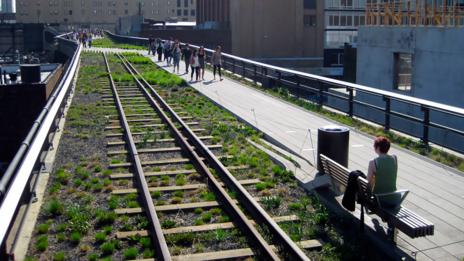
The Highline is a perfect case of adaptive reuse. This former elevated railway was converted into a public promenade and restorative ecological spine for the city. The raised streetscape helps retain rainwater, over 200 plant species, recreational green space; the freight trains are gone, replaced by people walking and cycling.
The Lowline, meanwhile, is a strategy to position state-of-the-art solar equipment to illuminate a discarded underground trolley station on the Lower East Side of NYC. This concept is to create an appealing underground common space, delivering an attractive ecological space within the heart of this crowded metropolitan environment.
Then there is Vision 42. This enterprise re-imagines an upgraded light rail transport at Midtown Manhattan as an alternative to traffic congestion. It’s designed as a crosstown, low-floor moderate speed train line traversing river-to-river at 42nd Street. Alongside is a landscaped tree-lined pedestrian street path. Vision 42 is a prototype for an entire network of walkable streets, greenways, and smart transports throughout a future New York.
Brooklyn Navy Yard (BNY) is a national model for sustainable industrial parks and green development, and home to companies that aim to be socially responsible and tech-driven, such as Terreform, the think-tank that I work for. The BNY is a former military industrial complex, converted into a clean technology and local manufacturing site; something that will be of utmost importance in any future metropolis.
This future city will still have traffic fumes as long as there are gas-guzzling vehicles plying its streets. But improving technology will enable the populace to steer clear of the most polluted zones. NYC Breathe is a wireless pollution sensor that keeps track of urban contaminants. These sensors are added to trucks, taxis, and automobiles and thus accumulate comprehensive pollution data in real-time – all of which is conveniently displayed as a detailed map.
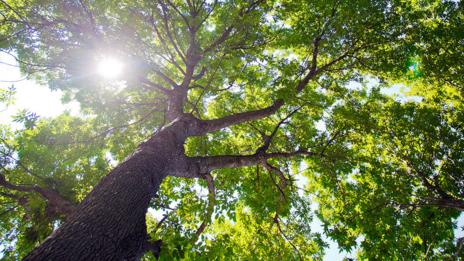
But steps are already being taken to make the city help cleans its air. Million Trees NYC has a goal of increasing its cosmopolitan woodland by planting many more trees. Street trees, park trees, and trees on public, private and commercial land are highly valuable. By planting a million trees, we can increase New York’s urban forest by an overwhelming 20%, while accomplishing the numerous quality-of-life advantages that come with them. The City of New York will plant 70% of trees in parks and other public spaces. The other 30% will come from private organisations, homeowners, and community organisations.
And what of food? Vertical Aquaponics can yield up to 800% more produce than traditional land farming in an equivalent space, while consuming 90-95% less water and power. Farms will be constructed in stacks, rising into the air. By assembling aquaponic farms vertically, it multiplies the power of its food-growing equipment, possibly yielding far more food than conventional farming – and all the time using a fraction of the space and energy.
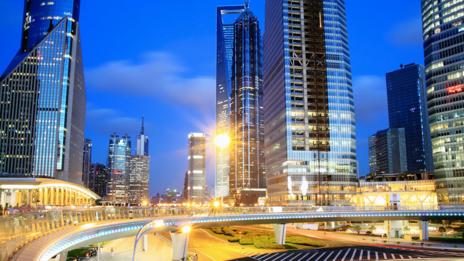
But revisioning Manhattan is more than just an academic exercise, and needs more than what is on the drawing board now. The climate is skewed and cities are partly responsible. We need to act now to observe action later. Many advocates of sustainability encourage operations to achieve the bare minimum or zero impact. These efforts try to do no further harm, but do not try to heal. We need to elevate subsistence-based systems to approaches that not only have a positive impact but are abundant throughout the city. Calculating an ecological footprint is suitable for endurance living. Reversing the effects of pollution is better still.
If Manhattan was restructured to be proactive in resetting the climate, other cites may follow. How can we do this? This next version of New York is dependent on planning and preparation. This next version of New York is dependent on us.
This is a Sample Heading for the NewsPress Theme
BBC: New York has, over the last few centuries, become one of the world’s most densely packed cities. But what if you could redraw the city’s map – and build it from scratch?
If we were designing New York today, how different would it look?
The new New York City would balance the relationship between the information networks that the metropolis depends on and Earth’s finite resources.
All vital components of life would be monitored and attuned to the needs of every organism, not just humans. Supplies of food and water, our energy and waste and even our air would be sensibly scrutinised. Thanks to masses of miniaturised low-cost electronic components deployed across the city, communication becomes far easier. New York will grow and adapt to millions of new minds entering it everyday.
The city would make sure every need is provided for within its borders. How we provide nutrients, transports, and shelter would be updated. Dilapidated buildings would be replaced with vertical agriculture and new kinds of housing would join cleaner, greener ways to get around the city. What were once streets become snaking arteries of livable spaces, embedded with renewable energy sources, low-tech, green vehicles for mobility and productive nutrient zones. The former street grid could provide the foundation for new flexible networks. By reengineering the obsolete streets, we can create robust and ecologically active pathways.
While all this may sound optimistic, some of this city of tomorrow is already taking shape.
The Highline is a perfect case of adaptive reuse. This former elevated railway was converted into a public promenade and restorative ecological spine for the city. The raised streetscape helps retain rainwater, over 200 plant species, recreational green space; the freight trains are gone, replaced by people walking and cycling.
The Lowline, meanwhile, is a strategy to position state-of-the-art solar equipment to illuminate a discarded underground trolley station on the Lower East Side of NYC. This concept is to create an appealing underground common space, delivering an attractive ecological space within the heart of this crowded metropolitan environment.
Then there is Vision 42. This enterprise re-imagines an upgraded light rail transport at Midtown Manhattan as an alternative to traffic congestion. It’s designed as a crosstown, low-floor moderate speed train line traversing river-to-river at 42nd Street. Alongside is a landscaped tree-lined pedestrian street path. Vision 42 is a prototype for an entire network of walkable streets, greenways, and smart transports throughout a future New York.
Brooklyn Navy Yard (BNY) is a national model for sustainable industrial parks and green development, and home to companies that aim to be socially responsible and tech-driven, such as Terreform, the think-tank that I work for. The BNY is a former military industrial complex, converted into a clean technology and local manufacturing site; something that will be of utmost importance in any future metropolis.
This future city will still have traffic fumes as long as there are gas-guzzling vehicles plying its streets. But improving technology will enable the populace to steer clear of the most polluted zones. NYC Breathe is a wireless pollution sensor that keeps track of urban contaminants. These sensors are added to trucks, taxis, and automobiles and thus accumulate comprehensive pollution data in real-time – all of which is conveniently displayed as a detailed map.
But steps are already being taken to make the city help cleans its air. Million Trees NYC has a goal of increasing its cosmopolitan woodland by planting many more trees. Street trees, park trees, and trees on public, private and commercial land are highly valuable. By planting a million trees, we can increase New York’s urban forest by an overwhelming 20%, while accomplishing the numerous quality-of-life advantages that come with them. The City of New York will plant 70% of trees in parks and other public spaces. The other 30% will come from private organisations, homeowners, and community organisations.
And what of food? Vertical Aquaponics can yield up to 800% more produce than traditional land farming in an equivalent space, while consuming 90-95% less water and power. Farms will be constructed in stacks, rising into the air. By assembling aquaponic farms vertically, it multiplies the power of its food-growing equipment, possibly yielding far more food than conventional farming – and all the time using a fraction of the space and energy.
But revisioning Manhattan is more than just an academic exercise, and needs more than what is on the drawing board now. The climate is skewed and cities are partly responsible. We need to act now to observe action later. Many advocates of sustainability encourage operations to achieve the bare minimum or zero impact. These efforts try to do no further harm, but do not try to heal. We need to elevate subsistence-based systems to approaches that not only have a positive impact but are abundant throughout the city. Calculating an ecological footprint is suitable for endurance living. Reversing the effects of pollution is better still.
If Manhattan was restructured to be proactive in resetting the climate, other cites may follow. How can we do this? This next version of New York is dependent on planning and preparation. This next version of New York is dependent on us.